
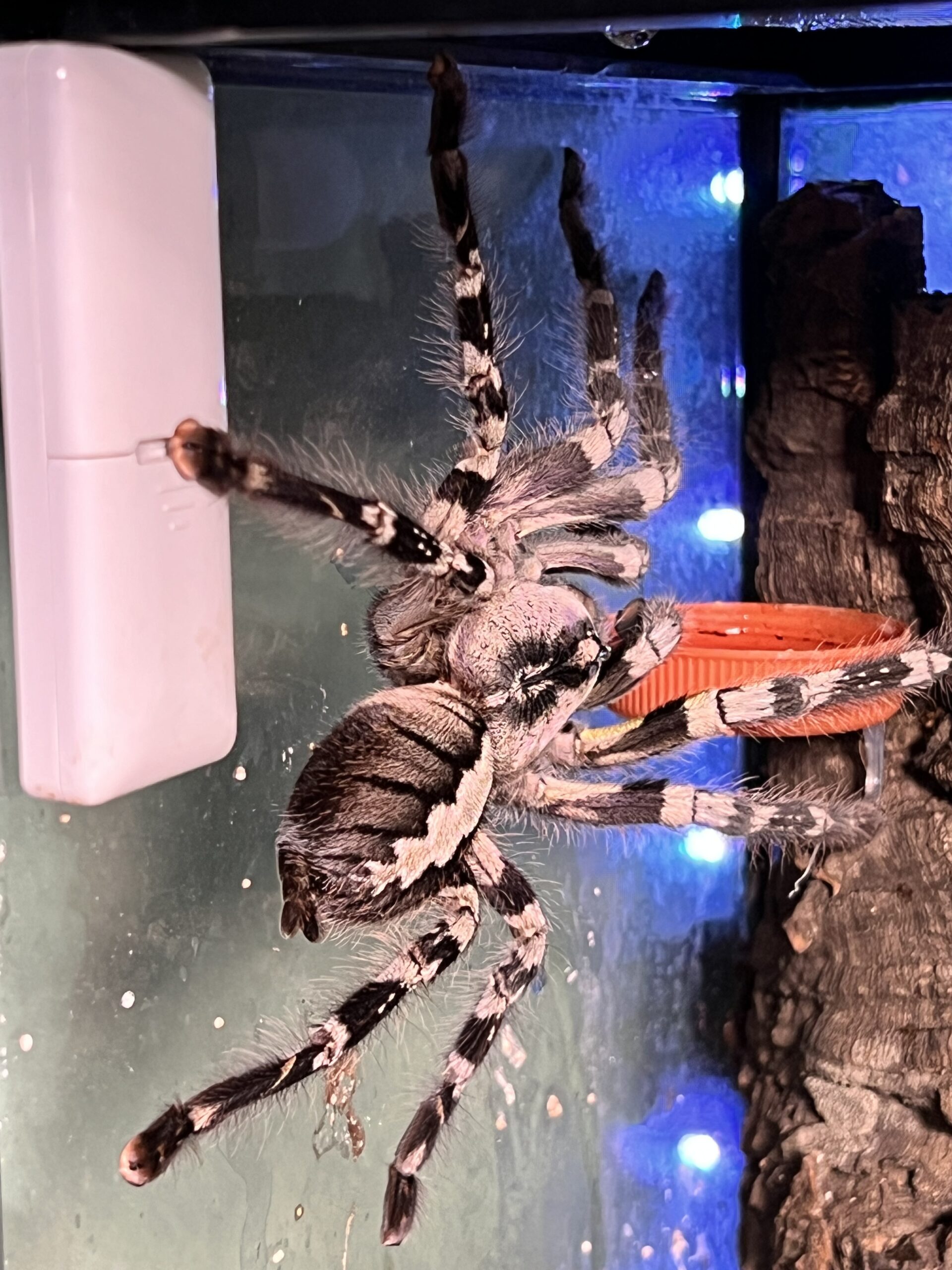
Some tarantulas look good in photos and then feel a little ordinary in person. Poecilotheria regalis is not one of them. The Indian ornamental has that classic Poecilotheria look, all bark-camouflage gray, black patterning, and those bright yellow tones under the front legs, but what really sticks with you is how alert it seems. Even sitting still, it looks ready to vanish around the back of a cork tube in half a second.
This species comes from southeastern India, where it lives high up in trees and uses hollows or tight bark crevices as retreats. That arboreal lifestyle explains a lot about how it behaves in captivity. It wants height, cover, and a place to disappear into during the day. At night it tends to show itself more, and when it does, the long legs and crisp patterning make it easy to see why Poecilotheria regalis became such a favorite with collectors.
It is also a species that deserves respect. Adult females can reach roughly a 7 inch leg span, they grow fairly quickly, and they are famously fast. Most keepers who have spent time with Poecilotheria know the deal already: this is not a tarantula for casual handling, and it is not one to underestimate during maintenance. Like other old world species, it lacks urticating hairs and relies more on speed, posture, and venom as defense. That is a big part of why experienced keepers, not beginners, usually do best with it.
What I like most about P. regalis is the contrast. It is beautiful without looking delicate, and flashy without losing that wild, practical design. The white abdominal banding underneath gives it away instantly if you know what you are looking at. In the wild, though, the same spider can disappear against tree bark almost too well. That mix of elegance and raw efficiency is probably why the Indian ornamental still feels like one of the signature species in the hobby.
Wild populations are under pressure from habitat loss, which makes captive-bred animals the right way to appreciate this species. For keepers who enjoy fast arboreals and know how to set them up safely, Poecilotheria regalis is easy to admire and hard to forget.